
 Print
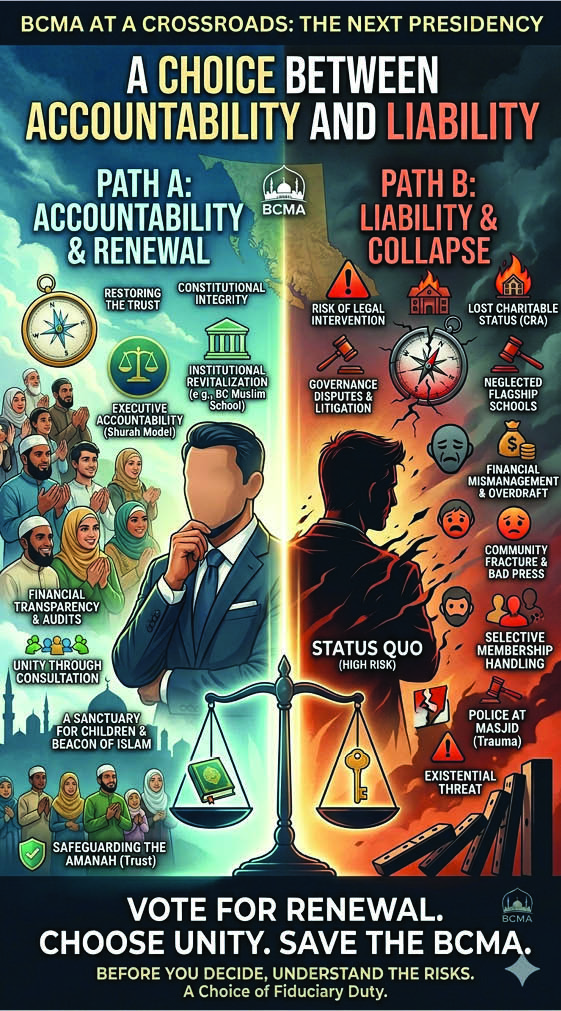
BCMA at a Crossroads: The Next Presidency—A Choice Between Accountability and Liability
3-25-2026
As the BC Muslim Association (BCMA) approaches the selection of its next President, this is not a routine leadership transition—it is a defining moment that will determine the trajectory of the institution for years to come. After more than six decades of community service, BCMA now stands at a crossroads where the choice before members is stark: embrace accountability and renewal, or risk further erosion of trust through continuity of past practices.
Much has been said about “rebuilding confidence,” “unity,” and “safeguarding the Amanah.” These are important words. But words alone cannot resolve what has become a deepening governance, legal, and financial crisis. Members are no longer concerned with messaging—they are demanding clarity, responsibility, and decisive action.
At the heart of this election lies a fundamental concern: the growing gap between constitutional obligations and actual governance practices. The BCMA Constitution and the British Columbia Societies Act are not symbolic frameworks; they impose binding duties—fiduciary responsibility, transparency, proper record-keeping, and accountability to members. Yet the Association now faces credible allegations and unresolved issues that suggest these standards have not consistently been upheld.
Among the most pressing concerns is the integrity of the electoral and membership processes. Allegations of irregularities, including interference with independent committees and questionable membership approvals, have cast doubt on the legitimacy of internal democracy. When election oversight itself becomes a subject of dispute, the risk of further Special General Meetings or even court challenges become not hypothetical, but absolute necessity to safeguard the association from being exposed to further abuse, and to secure it for our future generations.
Compounding this is the growing legal exposure facing the organization. Reports of legal actions initiated without proper Executive Council approval raise serious governance concerns. At the same time, ongoing disputes involving former directors and public statements risk escalating into defamation claims. These are not abstract risks—they carry real financial consequences and potential personal liability for directors under the law.
Financial oversight presents another area of concern. Questions remain about why irregularities and delays in audited financial reporting were not adequately addressed at the Executive level. The failure to ensure timely auditor reports and proper internal controls not only undermines transparency but may also expose the organization to regulatory scrutiny. In an environment where charities face increasing oversight, particularly through CRA audit programs, any perception of weak governance or internal conflict places BCMA’s charitable status at risk.
Equally troubling is the apparent stagnation in internal audit processes and the lack of implementation of member-approved resolutions. Motions passed at previous SGMs—calling for investigations, financial corrections, and independent oversight—remain unresolved. This raises a critical question: will the next President respect and execute the will of the membership, or reinterpret it in ways that preserve executive control?
The growing call for a forensic audit reflects a broader demand for transparency. While not legally mandated, such an audit is within the rights of members and could serve as a necessary step toward restoring confidence. The next president’s position on this issue will signal whether they are prepared to confront the past honestly or avoid scrutiny altogether.
Beyond governance and legal matters lies the issue of public perception. Internal disputes have increasingly spilled into public and media spaces, often through unverified claims and informal communication channels. This not only damages the reputation of the Association but also heightens legal risk. A credible plan for professional, accountable communication is no longer optional—it is essential.
Yet perhaps the most difficult question facing members is one of continuity. Can a candidate who has been part of the current leadership structure convincingly distance themselves from the decisions and policies that contributed to the present situation? If so, they must clearly articulate where they stand, what they would change, and where they accept responsibility. Without such clarity, calls for “restoring trust” risk being perceived as rebranding rather than reform.
The consequences of inaction are significant. Legal liabilities, operational deficits, and governance failures do not disappear—they accumulate. Left unaddressed, they threaten not only the financial stability of the Association but also its institutional integrity and historical legacy.
At the same time, the human dimension cannot be ignored. The membership is visibly divided, with increasing recourse to SGMs, legal actions, and demands for independent investigations. Rebuilding unity will require more than appeals for harmony—it will require a demonstrated commitment to fairness, transparency, and inclusion in decision-making processes.
This is where fiduciary responsibility must be understood in its fullest sense. Directors are not merely administrators; they are trustees of an Amanah entrusted by the community. Their duty is not to preserve positions or manage optics, but to act in the best interests of the organization with diligence, integrity, and accountability. Should the Association face regulatory sanctions or legal intervention, responsibility will not be diffuse—it will be specific and enforceable.
The next President, therefore, must be more than a figurehead. The role demands a leader capable of navigating legal complexity, restoring financial discipline, and rebuilding institutional credibility. It requires someone prepared to support independent audits, enforce constitutional processes, manage liabilities, and engage transparently with both members and the broader public.
Ultimately, this election is not about personalities or affiliations. It is about governance. It is about whether BCMA will recommit itself to the principles enshrined in its Constitution—consultation, accountability, and structured decision-making—or continue along a path where those principles are tested and, at times, disregarded.
Members must ask themselves difficult but necessary questions. Will the next President uphold governance frameworks or seek to control them? Will they prioritize accountability or perception? Will they work to unite a divided membership or inherit and perpetuate that division?
The answers to these questions will determine more than the outcome of an election—they will define the future of the BC Muslim Association.
The choice is clear: rebuild trust through transparency and accountability or risk the legacy of an institution built over generations an anomaly for our children.
Footnotes:
|