| |

 Print
FIFA Protests Spotlight Palestinian Struggle and Question Football’s Moral Compass
6-24-2026
As the 2026 FIFA World Cup unfolds across host cities in Canada, the United States, and Mexico, a wave of pro-Palestinian protests has surged at multiple venues, thrusting the world’s most popular sport into a fraught intersection of politics, human rights, and international law.
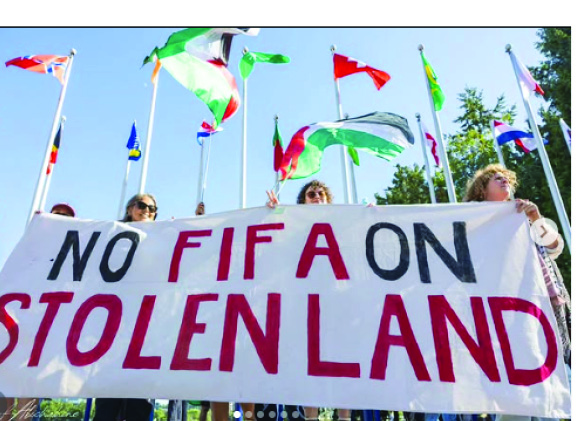
From Toronto and Vancouver in Canada to Mexico City and Arlington in the U.S., demonstrators have organized coordinated actions—unfurling banners, staging chants, and deploying peaceful demonstrations timed with key matches. A striking example was in June 2026 in Toronto, where activists displayed a large “Kick Israel Out of FIFA” banner near the stadium, linking FIFA’s governance to the ongoing humanitarian crisis in Gaza and Israel’s occupation policies. [Reuters]
These protests are not isolated expressions of dissent. They represent a growing global movement demanding accountability from FIFA, accused of failing to uphold its own statutes and international human rights obligations. Central to the protests is FIFA’s continued acceptance of Israeli football clubs operating in occupied Palestinian territories, including at least six to eight clubs based in illegal settlements in the West Bank. UN human rights experts declared in October 2024 that such activity violates international law and warned FIFA it cannot claim neutrality while these violations persist. Amnesty International later condemned FIFA’s refusal to suspend these clubs as a direct flouting of international law and FIFA’s own rules on territorial jurisdiction. [UN, Amnesty International]
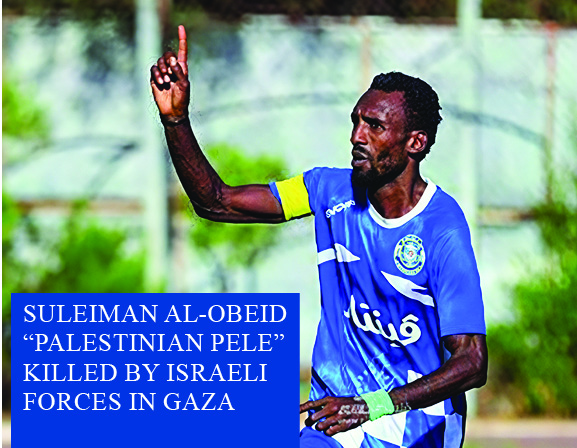
The humanitarian toll behind the protests is profound and deeply personal for the Palestinian soccer fraternity. The Palestinian Football Association reported in March 2026 that 1,007 members of Gaza’s sports community—players, coaches, referees, and officials—have died since October 2023, with 565 football-related fatalities alone. These losses include celebrated figures such as Suleiman al-Obeid, dubbed the “Palestinian Pelé,” killed in Israeli strikes, and countless others who perished waiting for humanitarian aid. The destruction extends beyond lives lost: stadiums, training grounds, and club facilities have been severely damaged, crippling Palestinian football infrastructure and halting the development of future generations. [WAFA, The Guardian]
FIFA, as the global guardian of football, faces mounting criticism for its selective enforcement. While the organization sanctioned Russia following the 2022 invasion of Ukraine, it has refrained from banning Israeli clubs tied to settlements, citing “unresolved legal complexities.” This perceived inconsistency fuels allegations that FIFA’s stance enables the normalization of occupation and discrimination, contradicting its professed commitment to equality, anti-discrimination, and fair play. [Reuters, Amnesty International]
The protests at FIFA venues are thus more than political statements—they are urgent demands that football not be complicit in systemic injustice. Activists argue that by allowing Israeli settlement clubs to compete and by neglecting the staggering human cost on Palestinian athletes and communities, FIFA undermines its own credibility and the sport’s universal values.
For host nations like Canada, these protests resonate with local Muslim and Arab communities, highlighting tensions between multiculturalism, free speech, and international politics. The demonstrations underscore how global sporting events intersect with broader social justice movements and the struggle for human rights.
Ultimately, these protests raise a fundamental question: can FIFA maintain moral authority when its actions—or inactions—appear to condone violations of international law and disregard the lives and dignity of Palestinian sportspeople? The answer will shape not only the future of football governance but also the role of sport as a platform for justice in an increasingly interconnected world.
As the World Cup continues, the banners, chants, and peaceful protests at FIFA venues serve as powerful reminders that sport cannot be divorced from the realities faced by those it claims to represent. They call on FIFA to live up to its own standards and to ensure that football truly embodies fairness, respect, and humanity—for all players, on and off the pitch.
Footnotes:
|