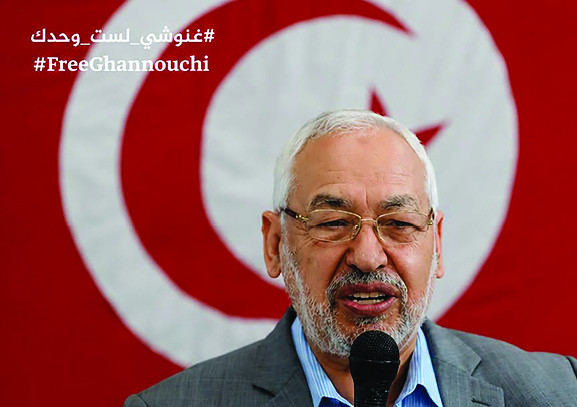
At Issue: U.S. Advocacy Group Calls for Emergency Release of Sheikh Rached Ghannouchi Amid Extreme Heat Wave
7-26-2026
 Email
to a friend Email
to a friend
 Post
a comment Post
a comment
 Print Print
The trigger: As a punishing heat wave grips Tunisia, reports that 85-year-old jailed opposition leader Rached Ghannouchi lost consciousness inside Mornaguia Prison have set off a fresh wave of appeals from U.S.-based advocacy and human rights groups demanding his immediate, humanitarian release.
What happened
Tunisia has been enduring an intense summer heat wave, with temperatures in parts of the country topping 45°C (113°F) and, according to one witness account, reaching as high as 52°C (126°F) inside Mornaguia Prison. The extreme heat has coincided with strain on the national electricity grid, producing power cuts in several regions as demand for air conditioning surges.
Against that backdrop, Haifa Chebbi — daughter of another jailed opposition figure, Ahmed Nejib Chebbi — said in a video posted after visiting the prison that she witnessed Ghannouchi, the former speaker of Tunisia's parliament and longtime head of the Ennahda party, briefly lose consciousness. She described leaving the facility feeling barely able to breathe, and urged Tunisian civil society to move past expressions of online solidarity toward concrete action.
Ghannouchi has been imprisoned since April 2023 and was previously hospitalized in April 2026 after a sharp deterioration in his health. In June 2026, a Tunis court sentenced him to life in prison plus 30 additional years in a case centered on allegations that Ennahda operated a clandestine security wing — a case his defense and international observers have characterized as politically motivated rather than judicial.
The advocacy response
The reported collapse has amplified calls that were already building. Washington-based groups have been especially vocal:
The Center for the Study of Islam and Democracy (CSID), based in Washington, D.C., announced in July that more than 400 former heads of state, scholars and civil society leaders from over 30 countries had signed an international appeal for Ghannouchi's unconditional release. CSID president Radwan Masmoudi framed it as a rare point of consensus among signatories who otherwise disagree on much else — namely, that an elderly man should not die in prison for his political beliefs.
DAWN (Democracy for the Arab World Now), also headquartered in Washington, called in June for Ghannouchi's conviction to be vacated, describing the life sentence as part of a broader pattern of using the courts to sideline critics of President Kais Saied.
Amnesty International has separately urged Tunisian authorities to guarantee adequate ventilation, water access, medical care and cooling for older and chronically ill detainees during the heat wave, without commenting specifically on Ghannouchi's political case.
Malaysia-based Islamic civil society coalition HIKAM issued a similar humanitarian appeal, framing it explicitly as independent of any endorsement of Ghannouchi's politics.
Underpinning these statements is a shared argument: that humanitarian release on medical grounds is a distinct question from the political dispute over Ghannouchi's guilt or innocence, and that his age and documented health decline create an urgent, time-limited risk to his life.
The broader context
Ghannouchi's detention is one strand of a wider crackdown that began after President Saied suspended parliament and began ruling by decree in July 2021, an action his critics call a constitutional coup and which marked its fifth anniversary this month. Dozens of opposition figures, lawyers, journalists and activists have since been prosecuted in cases their supporters describe as politically motivated; Tunisian authorities maintain the prosecutions concern genuine threats to state security rather than political expression. The UN Working Group on Arbitrary Detention has previously found Ghannouchi's imprisonment to be arbitrary, though Tunisian officials have disputed that characterization.
The heat wave has added a new, more immediate dimension to a years-long standoff: reports indicate the current power crisis has been linked to well over 100 deaths nationally amid prolonged blackouts, underscoring that prison conditions are unfolding within a broader national emergency rather than in isolation.
What's at stake
For advocacy groups, the heat wave has reframed a long-running political and legal dispute as an acute humanitarian one, betting that appeals centered on age, health and basic prisoner welfare can draw support — including from people who take no position on Ennahda or Tunisian politics — that a purely political appeal could not. Whether that pressure translates into any change in Ghannouchi's detention conditions or legal status remains, as of this writing, an open question; Tunisian authorities have not announced any humanitarian release measures in response to the recent appeals.
This piece draws on reporting from Al Jazeera, Middle East Eye, Middle East Monitor, Euronews, and statements published by CSID, DAWN, Amnesty International and HIKAM.
|