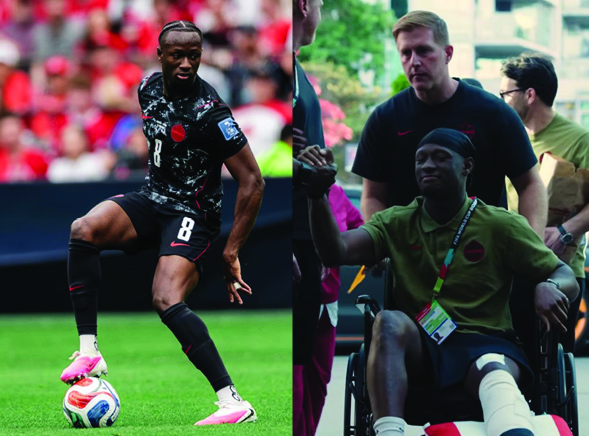
Ismaël Koné Injury Shapes Canada’s 6–0 World Cup Win Over Qatar at BC Place Vancouver
Jafar Bhamji
6-23-2026
 Email
to a friend Email
to a friend
 Post
a comment Post
a comment
 Print Print
VANCOUVER — Canada’s commanding 6–0 victory over Ismaël Koné and Qatar national football team at BC Place was defined by more than goals and attacking fluency. It was also shaped by a sudden, emotional turning point—the injury to midfielder Ismaël Koné, whose early influence had set the tone for Canada’s dominance before the match shifted into a moment of collective concern.
The result strengthened Canada’s position in the FIFA World Cup group stage, but the evening will be remembered as much for its human dimension as for its scoreline.
Koné’s early control and Canada’s midfield rhythm
Before the injury, Koné played a central role in Canada’s midfield structure, acting as a stabilising link between defence and attack. His pressing intelligence and ability to carry the ball through pressure allowed Canada men's national soccer team to dictate tempo from the opening minutes.
Canada’s approach relied on aggressive vertical transitions and coordinated right-sided overloads. Koné frequently operated as the connective presence, balancing risk and control while opening passing lanes for advancing attackers.
Tactically, his movement off the ball helped stretch Qatar’s compact defensive block, allowing Canada to sustain pressure in advanced areas. Early data reflected that control, with Canada generating sustained attacking sequences and high territorial dominance inside Qatar’s half.
Early dominance and structural pressure
From kickoff, Canada displayed a level of intensity consistent with a team increasingly comfortable on football’s biggest stage. Midfield rotations and wide expansions repeatedly forced Qatar deep into a defensive block, limiting their ability to transition forward.
Canada’s midfield structure proved especially effective in recovering second balls and recycling possession, maintaining long periods of pressure. By the end of the first half, Canada had established clear attacking superiority, with expected goals (xG) estimates exceeding 1.6 before the break.
Qatar struggled to escape Canada’s pressing structure, often pinned back by quick turnovers and sustained territorial control.
The collision that changed the match
Midway through the first half, the game’s emotional tone shifted abruptly. Koné was involved in a heavy midfield collision during a challenge with Qatar’s Assim Omer Madibo. The impact required immediate medical attention, and play was halted as staff rushed onto the pitch.
The atmosphere inside BC Place changed instantly. Players from both sides signaled concern as Koné received treatment on the field. He was eventually stretchered off, prompting visible emotional reactions from teammates and supporters.
The incident forced an immediate tactical reassessment from Canada’s bench. While momentum remained intact, the team shifted into a more conservative 4-2-3-1 structure, prioritising stability over fluid central rotations.
Tactical adjustment and squad resilience
Without Koné’s forward progression and pressing coverage, Canada adjusted its midfield responsibilities. Deeper distribution became more prominent, with greater emphasis on structured buildup rather than central overloads.
Despite the disruption, Canada maintained control of the match and extended its lead, demonstrating squad depth and tactical adaptability under pressure.
The shift altered the rhythm of the game—less dynamic through central channels, but still effective in wide areas where Canada continued to exploit space. The response was widely viewed as a test of composure and depth in a high-stakes tournament environment.
Qatar’s response and sportsmanship
Following the match, Qatar players expressed remorse and support for Koné after the challenge that led to his injury.
“We feel sorry for him,” said Yusuf Abdurisag of Qatar national football team, acknowledging the severity of the incident.
Defender Sultan Al-Brake also offered an apology, stating:
“Our player didn't mean to do it. I hope he makes a full recovery. That’s football for you.”
The tackle resulted in a red card for Assim Omer Madibo during Canada’s dominant win, adding further controversy to an already emotionally charged moment.
Koné’s message of faith and resilience
In the aftermath, Koné shared a reflective message on social media, focusing on faith, gratitude, and resilience:
“AllAH has never failed me. Throughout my life, not even once. So why doubt Him now? Especially knowing that He knows and sees everything before it even happened. He has a plan and a vision for all of us. This battle is test to my faith in Him and to my character.”
He added:
“And honestly I’m ready for it because, ALLAH will never give you a challenge that you can’t overcome and being tested is the best of gift from God. Your love and support has been felt… I thank God for that because not everyone is this fortunate.”
The message resonated widely among supporters, reflecting Koné’s growing profile not only as a footballer but as a public figure grounded in faith and gratitude.
Surgery update and recovery outlook
Subsequent updates confirmed that Koné underwent successful surgery for a lower limb fracture. Medical reports indicate he is expected to make a full recovery, though he will miss the remainder of the FIFA World Cup 2026 tournament.
Support messages from teammates, fans, and football communities across Canada and abroad have continued to circulate, with many highlighting his importance to Canada’s midfield identity.
A club and team update also reinforced optimism:
“You will come back stronger, Isma!” read one official message shared by supporters and team channels.
A “hero’s welcome” from supporters
As news of his condition spread, supporters responded with a wave of encouragement, describing Koné as a key figure in Canada’s evolving football identity.
“A hero’s welcome for our guy Isma,” read one widely shared message among fans, reflecting the emotional connection between the player and supporters across the Canadian football landscape.
Conclusion: a win defined by more than goals
Canada’s 6–0 victory over Qatar will be recorded as a statement performance in the World Cup group stage. Yet the defining image of the night may not be a goal celebration, but the moment Koné left the pitch surrounded by concern and silence.
For Ismaël Koné, the match became a turning point marked by both physical setback and emotional solidarity. For Canada men's national soccer team, it became a test of adaptability, depth, and unity.
As the tournament continues, Canada’s challenge will be sustaining momentum while navigating the loss of a key midfield figure. But at BC Place, the message was already clear: this team’s identity is built not only on goals, but on resilience in the moments that interrupt them.
|